

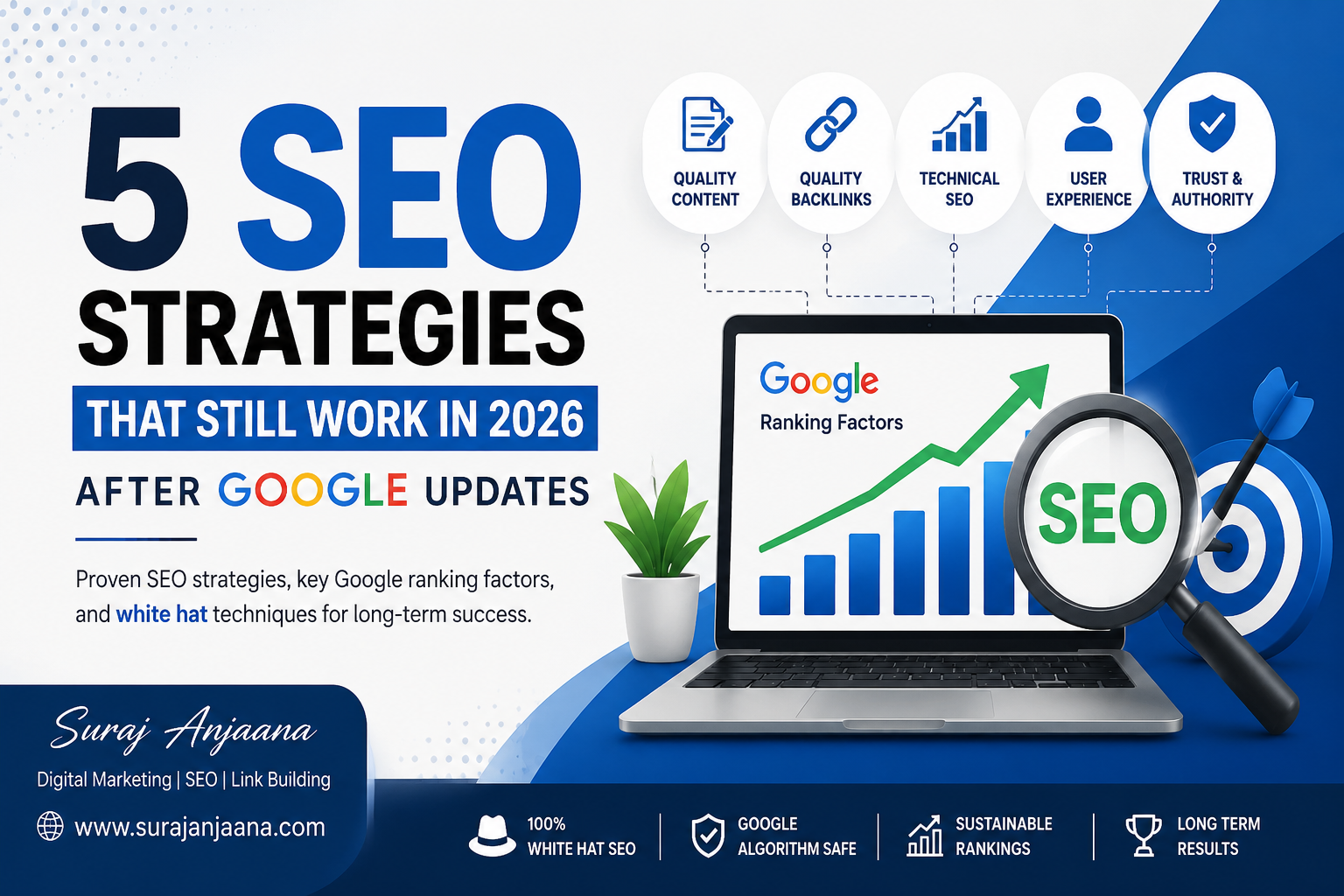

The Truth About SEO in 2026: What Still Works After Google’s Constant Updates
Every year, digital marketers hear the same prediction: “SEO is dead.”
Yet businesses continue investing in search engine optimization because organic search remains one of the most profitable and sustainable marketing channels available. What has changed is not SEO itself, but the methods required to achieve and maintain strong rankings.
Google’s updates throughout recent years have focused heavily on rewarding quality, relevance, expertise, user experience, and genuine value while reducing the visibility of low-quality content, manipulative link-building tactics, and AI-generated content created solely for search engines.
For website owners, business owners, bloggers, and digital marketers, the challenge is understanding which SEO strategies continue to deliver results and which outdated tactics should be abandoned.
In this guide, we will explore the latest SEO strategies that continue to work in 2026, examine the most important Google ranking factors, and explain why investing in professional white hat SEO services remains the safest path to long-term success.
Understanding Google’s Direction in 2026
Google’s primary objective has never changed: deliver the most relevant and trustworthy result for every search query.
Recent updates have become increasingly effective at identifying:
- Helpful content
- User satisfaction signals
- Content expertise
- Website authority
- Trustworthiness
- Brand reputation
- Natural backlink profiles
- Real-world business credibility
This means SEO is no longer about finding shortcuts. Instead, it is about building genuine digital authority.
Businesses that focus on providing value continue to rank, while websites relying on manipulative techniques often experience ranking declines.
Latest SEO Strategies That Still Work in 2026
1. Creating Helpful and Experience-Based Content
One of the strongest ranking signals today is content that demonstrates real experience.
Google wants content created by people who have genuine knowledge, practical expertise, and firsthand experience with a topic.
Instead of publishing generic articles, focus on:
- Case studies
- Personal experiences
- Industry insights
- Original research
- Real project examples
- Client success stories
For example, if you run an SEO agency, sharing actual ranking improvements, traffic growth reports, and link-building campaigns can significantly strengthen your content’s credibility.
The websites achieving the best rankings are often those publishing information that competitors cannot easily replicate.
2. Topical Authority Is More Important Than Individual Keywords
Many website owners still focus on ranking single pages for individual keywords.
In 2026, Google’s algorithms evaluate whether your entire website demonstrates authority in a subject area.
For example, a digital marketing website should cover topics such as:
- SEO
- Link building
- Local SEO
- Technical SEO
- Content marketing
- Social media marketing
- Website optimization
- Google Business Profile optimization
Publishing comprehensive content across related topics helps establish topical relevance and authority.
This strategy significantly improves overall visibility and ranking potential.
3. White Hat Link Building Continues to Deliver Results
Despite countless algorithm updates, backlinks remain among the strongest Google ranking factors.
However, not all backlinks are equal.
Google increasingly rewards:
- Contextual backlinks
- Editorial links
- Guest post links
- Niche-relevant links
- Authority website mentions
- Brand citations
At the same time, spammy links, automated links, private blog networks, and low-quality directories continue to lose effectiveness.
Professional white hat SEO services focus on earning links naturally through:
- Outreach campaigns
- Guest posting
- Digital PR
- Industry partnerships
- Resource page placements
- High-quality content promotion
Quality consistently outperforms quantity.
A few authoritative links can generate better results than hundreds of low-quality backlinks.
4. Search Intent Optimization
Understanding user intent has become critical.
Google wants to match searchers with content that satisfies their objectives.
There are generally four primary search intents:
Informational Intent
Users seek information.
Example:
“latest SEO strategies”
Navigational Intent
Users want a specific website.
Example:
“Suraj Anjaana SEO Blog”
Commercial Intent
Users compare services or products.
Example:
“best white hat SEO services”
Transactional Intent
Users are ready to take action.
Example:
“hire SEO consultant”
The best-performing pages align their content structure directly with search intent.
5. Technical SEO Remains Essential
Even exceptional content may struggle if technical SEO issues prevent search engines from properly crawling and indexing a website.
Technical SEO priorities in 2026 include:
- Fast loading speed
- Mobile responsiveness
- Core Web Vitals optimization
- Clean URL structure
- XML sitemaps
- HTTPS security
- Structured data implementation
- Crawlability improvements
A technically optimized website provides a better user experience while helping search engines understand content more efficiently.
6. User Experience Is a Ranking Signal
Google increasingly evaluates how users interact with websites.
Positive engagement metrics often indicate valuable content.
Factors influencing user experience include:
- Easy navigation
- Readable content formatting
- Mobile usability
- Internal linking
- Visual design
- Page speed
- Clear calls to action
When visitors stay longer, explore multiple pages, and engage with content, it sends positive quality signals.
7. Brand Building Has Become an SEO Strategy
Strong brands consistently perform better in search results.
Google recognizes brand mentions across the web and uses various trust indicators to evaluate business credibility.
Brand-building activities include:
- Publishing expert content
- Earning media coverage
- Growing social media presence
- Collecting positive reviews
- Participating in industry discussions
- Maintaining consistent branding
Businesses that invest in brand recognition often see stronger organic visibility over time.
8. Local SEO Continues to Grow
For businesses serving specific locations, local SEO remains one of the highest-ROI strategies.
Important local ranking factors include:
- Optimized Google Business Profile
- Local citations
- Customer reviews
- Location-specific content
- NAP consistency
- Local backlinks
Local search traffic often converts better because users are actively looking for nearby solutions.
9. Internal Linking Strategy Matters More Than Ever
Internal links help search engines understand relationships between content.
An effective internal linking structure:
- Distributes authority throughout the website
- Improves crawling efficiency
- Increases page discovery
- Enhances user navigation
Every important page should be connected to related content through relevant internal links.
This simple strategy often produces measurable ranking improvements.
10. Content Updates and Refreshes
Publishing content once is no longer enough.
Google favors content that remains accurate and relevant.
Successful websites regularly:
- Update statistics
- Add new insights
- Improve examples
- Expand content sections
- Refresh screenshots
- Enhance readability
Content refreshes can generate substantial ranking gains without creating entirely new articles.
Most Important Google Ranking Factors in 2026
Although Google uses hundreds of signals, several factors consistently influence rankings:
Content Quality
Comprehensive, accurate, and valuable content.
Search Intent Match
Content satisfies user expectations.
Backlink Authority
Quality backlinks from relevant websites.
User Experience
Fast, mobile-friendly, and engaging pages.
Technical SEO
Proper indexing and crawlability.
E-E-A-T Signals
Experience, Expertise, Authoritativeness, and Trustworthiness.
Brand Authority
Recognition and trust across the web.
Content Freshness
Regular updates and improvements.
Website Security
HTTPS and secure infrastructure.
Internal Linking
Strong content relationships.
Together, these factors form the foundation of sustainable SEO success.
SEO Tactics That No Longer Work
Many websites still rely on outdated methods that can cause ranking losses.
Avoid:
- Keyword stuffing
- Automated backlink building
- Spam comments
- Thin content
- Duplicate pages
- Hidden text
- Private blog network abuse
- AI-generated content without human editing
- Irrelevant backlinks
These tactics may provide short-term gains but often create long-term risks.
Why White Hat SEO Services Are the Safest Investment
Businesses looking for sustainable growth should prioritize white hat SEO services.
Unlike manipulative strategies, white hat SEO focuses on:
- Long-term rankings
- Search engine compliance
- User-focused optimization
- High-quality content
- Natural link acquisition
- Technical excellence
This approach reduces the risk of penalties while building lasting online authority.
The result is more stable rankings, consistent traffic growth, and stronger brand visibility.
Final Thoughts
SEO in 2026 is not about gaming algorithms. It is about understanding what Google ultimately wants: the best possible experience for users.
The latest SEO strategies focus on quality content, topical authority, user experience, technical excellence, and ethical link building. Businesses that embrace these principles continue to grow regardless of algorithm updates.
While Google’s systems will continue evolving, the fundamentals remain remarkably consistent: provide value, earn trust, and build genuine authority.
Organizations that focus on these proven principles will remain competitive and continue benefiting from organic search traffic for years to come.
If your goal is sustainable rankings and long-term online growth, investing in modern white hat SEO services and staying aligned with current Google ranking factors remains the most effective strategy available.
